

Musk and Cook flying to China with Trump. Google warning that AI is already helping find zero-days. The White House fighting internally over who owns AI model evaluations. OpenAI tightening its CEO governance. A dexterity-first robot foundation model quietly landing in industry trade press.
Different stories, same pattern: AI is no longer a product category, it’s an axis of state power, corporate control, and physical capability.
The center of gravity is shifting upward and outward. Heads of state are now part of your supply chain risk. Internal board politics at labs are now part of your platform risk. Inter-agency turf wars are now part of your compliance risk. And in the background, embodied AI is quietly expanding the set of tasks that can be automated in the real world.
If your current plan treats “AI” as a tooling decision inside your org, you’re under-scoping the problem. The real game is architecture, of governance, of security posture, of physical operations, and you are already a participant whether you’ve planned for it or not.

DEFENSE / GEO
AI is now a head-of-state and attacker tool, your roadmap is on their timeline, not yours
Musk, Cook, Trump, joint China trip on the table
Elon Musk and Tim Cook are reportedly planning to travel to China with Donald Trump, per Gizmodo. The reported agenda spans trade, tariffs, and tech, implicitly including EVs, iPhones, and AI-adjacent supply chains.
This is the clearest signal yet that core US tech operators are now direct instruments in geopolitical negotiation, not just lobbyists on the sidelines.
The Bet: US leadership is assuming that aligning incentives with a handful of tech CEOs is an effective lever on China-related supply chain and market access risk.
So What? Supply chain, data center buildout, and market access for AI hardware and devices are now negotiated at the head-of-state level. That means your dependency on Chinese manufacturing, rare earths, and user growth is no longer just a vendor management issue, it’s a foreign policy exposure. If you’re assuming stable access to Chinese fabs, assemblers, or users over a 5–10 year horizon, you’re implicitly betting on the durability of this political alignment.
The Risk: Political cycles are shorter than your capex cycles. A single election, sanction package, or export control tweak can invalidate multi-year manufacturing and infra plans. If your board hasn’t mapped this exposure, you’re flying blind.
Action:
- Map every dependency on China, manufacturing, components, data centers, and user acquisition, and quantify revenue and delivery at risk.
- Build a “China-offline” scenario for 24 months and identify which products, SKUs, or regions survive.
- Start parallel vendor conversations in at least one alternative geography, even if it’s just for optionality.
Google, AI-assisted zero-day discovery is now real
Google’s Threat Intelligence Group says it has found evidence of hackers using AI tools to discover a zero-day vulnerability, per Gizmodo AI. This follows separate reporting that tools like OpenClaw are already being used to find exploits, per CNBC.
Offensive security has gone AI-native before most enterprises have upgraded their own defenses.
The Bet: Attackers are assuming that AI-augmented exploit discovery and automation will outpace enterprise detection and patch cycles.
So What? Your threat model is outdated if it assumes human-limited discovery and exploitation speed. AI-assisted attackers can scan, reason about, and chain vulnerabilities at a pace your current SOC and patch processes were never designed for. This isn’t about “AI security” as a niche, it’s about your entire security posture being benchmarked against adversaries who are already using LLMs and code models as force multipliers.
The Risk: If you treat AI as a future security project, you’re effectively subsidizing attacker R&D. The dwell time between exploit discovery and mass exploitation is compressing, your current patch and incident response SLAs may be structurally too slow.
Action:
- Ask your CISO this week: “Where are we using AI in defense today?” If the answer is “nowhere,” treat that as a red flag.
- Prioritize AI-augmented code review and dependency scanning on internet-facing systems and critical internal services.
- Run a live-fire exercise assuming an AI-assisted attacker, measure time to detection and containment, not just theoretical coverage.
US government, turf war over who owns AI model evaluations
The White House’s Office of the National Cyber Director and the Commerce Department’s CAISI are reportedly fighting over which agency should lead AI model evaluations, per the Washington Post. Each wants to own the “scoreboard” for model safety and capability assessments.
Regulatory surface area for AI evals is now a power center, agencies are competing to define the metrics and the gatekeeping.
The Bet: Each agency is assuming that control over eval frameworks translates into long-term influence over AI policy, funding, and industry behavior.
So What? If you’re shipping advanced models or building on them, you’re not getting a single, clean federal interface. You’re getting overlapping, possibly conflicting evaluation regimes, each with its own reporting expectations, risk categories, and political incentives. That means compliance is not a one-time certification exercise; it’s an ongoing negotiation across multiple regulators whose mandates are still being defined.
The Risk: Betting your roadmap on alignment with one agency’s guidance could leave you exposed if another wins the turf war or imposes stricter standards. Fragmentation also increases the risk of contradictory requirements that are technically or operationally hard to satisfy simultaneously.
Action:
- Assign a single owner, not a committee, for tracking AI eval policy across ONCD, Commerce, NIST, and sector regulators.
- Design your internal eval stack to be modular, you should be able to plug in new metrics and reporting formats without re-architecting.
- Start logging and versioning eval results now; retroactive reporting will be painful if you don’t have a clean history.
GOVERNANCE / POWER
Lab control and equity stakes are now macro risk, not inside baseball
OpenAI, board makes it harder to fire Sam Altman
OpenAI has reportedly changed its bylaws to require a supermajority board vote to remove CEO Sam Altman, up from a simple majority, per Business Insider. This follows last year’s brief ouster and reinstatement.
The move hardens OpenAI’s strategic continuity, and locks in its current lab–platform–ecosystem integration model.
The Bet: OpenAI’s board is assuming that stability of leadership and strategy is more valuable than optionality to change course quickly under pressure.
So What? If you’re building on OpenAI’s stack, your platform risk profile just changed. Governance risk, sudden CEO removal, mission whiplash, is lower. Strategic course-correction risk is higher. The current trajectory, aggressive productization, ecosystem expansion, and monetization, is now structurally harder to reverse, even if external conditions or internal views shift.
The Risk: If the current strategy runs into technical, regulatory, or market headwinds, the board has made it harder to pivot leadership. That can lock customers and partners into a path that no longer matches their risk tolerance or regulatory environment.
Action:
- Revisit your 3–5 year dependency assumptions on OpenAI, treat their current roadmap as “sticky,” not easily redirected.
- Build explicit exit ramps in your architecture, abstraction layers, model-agnostic interfaces, and data portability, in case you need to rebalance across labs.
- Ask your account team directly how governance changes affect product and pricing commitments; get it in writing where possible.
Musk v. Altman, Ilya Sutskever’s ~$7B stake surfaces
Ilya Sutskever testified that his OpenAI stake is worth around $7B and that he had concerns about Altman for a year before the brief CEO ouster, per Bloomberg. In parallel, Satya Nadella testified that Elon Musk never contacted him about concerns that Microsoft’s investments violated any special terms, per CNBC.
The trial is putting internal governance, equity stakes, and partnership dynamics for AI labs into the public record.
The Bet: Equity-heavy comp structures assume that aligning key technical talent with upside will stabilize the lab. The testimony suggests the opposite, large personal stakes can amplify governance friction.
So What? A single technical co-founder with a multi-billion-dollar stake and strong views on alignment can now move markets, trigger board actions, and reshape lab strategy. For operators, that means “talent risk” at labs is now macro risk. Internal disputes are not just HR issues, they’re potential shock events for your platform and partnership strategy.
The Risk: If your AI roadmap is anchored on long-dated partnership terms or equity-linked collaborations, you’re exposed to governance-by-lawsuit. Once equity values hit tens of billions, every disagreement has an incentive to escalate into legal or regulatory arenas.
Action:
- Treat major lab governance events, lawsuits, board changes, founder departures, as first-order risk inputs in your vendor strategy, not background noise.
- Diversify critical workloads across at least two model providers where feasible; avoid single-lab chokepoints for core revenue streams.
- For any strategic partnership with equity components, stress-test what happens if the relationship ends up in court.
ROBOTICS / EMBODIED AI
Dexterity models are pulling high-skill physical work into the automation frontier
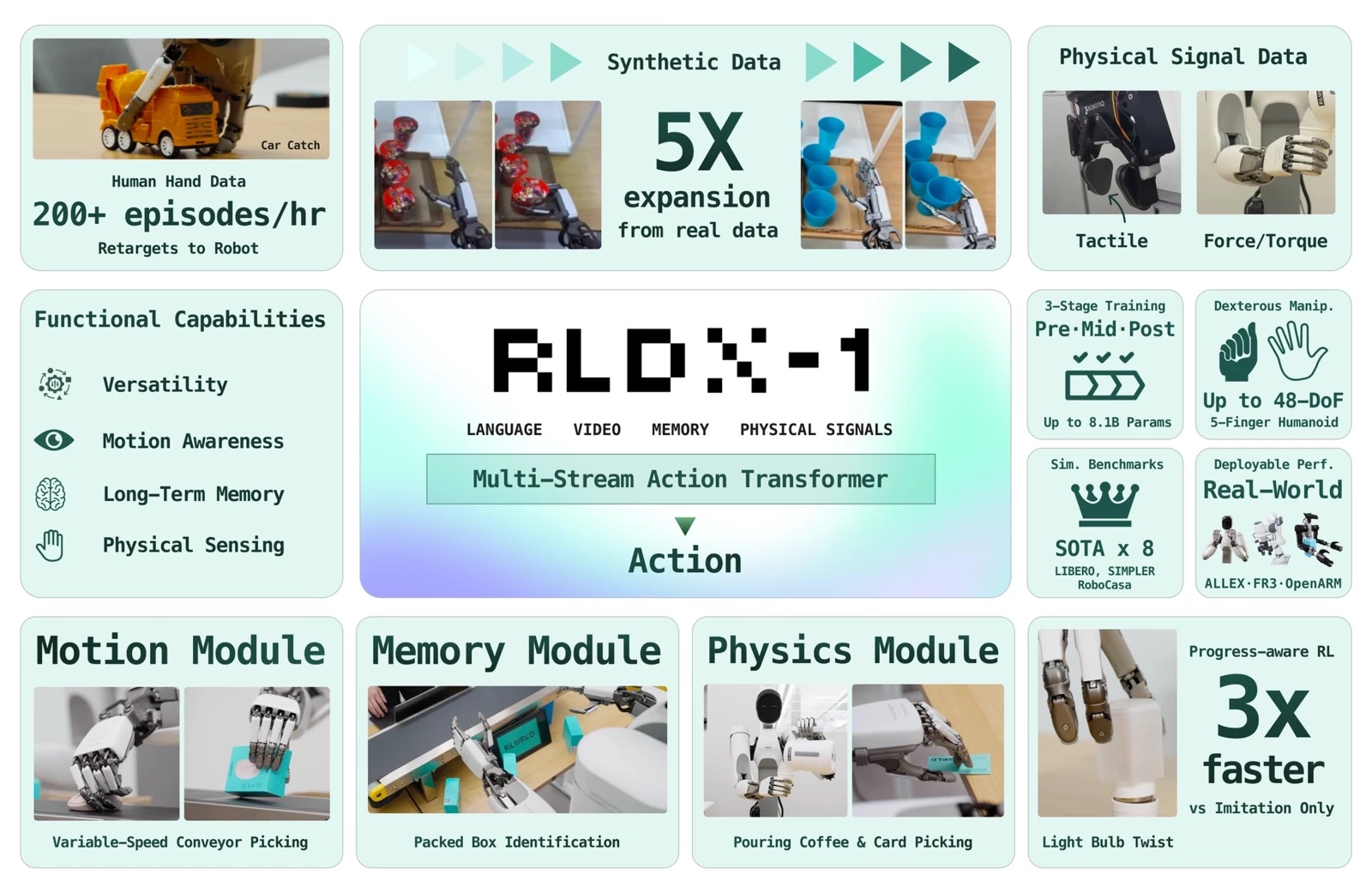
RLWRLD, launches RLDX-1, a dexterity-first foundation model for robot hands
RLWRLD released RLDX-1, a dexterity-first foundation model for robot hands with context memory and force sensing, per Robotics Business Review. The model is designed to handle fine manipulation tasks rather than just gross movement.
This shifts robots from “move this box” to “manipulate this object”, the difference between palletizing and real-world assembly.
The Bet: RLWRLD and its customers are assuming that generalizable dexterity, not just navigation or simple pick-and-place, is now tractable enough to productize over a 3–5 year horizon.
So What? High-dexterity tasks were the last refuge of human operators in many manufacturing, logistics, and service workflows. A foundation model focused on hand dexterity, with context and force feedback, expands the set of tasks that can be automated without bespoke programming for each SKU or fixture. This doesn’t just lower labor costs, it changes how you design products and lines when you can assume a capable, reprogrammable “hand” is available.
The Risk: Over-rotating into dexterous automation without redesigning upstream processes can create brittle systems, robots that technically can perform tasks but fail under real-world variance, maintenance constraints, or safety regimes.
Action:
- Audit your line or warehouse for tasks that are dexterity-constrained today, cable routing, small-part assembly, kitting, quality inspection, and list them explicitly.
- Start a vendor scan focused on dexterous manipulation, not just mobile robots or cobots; build a shortlist and get demos on your floor.
- In new product or line designs, assume a dexterous robot hand is an option, and see what that unlocks in fixture design, staffing, and throughput.
UX / AGENT SURFACES
The interface is becoming an app, HTML-native agents will obsolete chat UIs
Anthropic engineer, HTML is better than Markdown for agent output
An Anthropic engineer argued that HTML is a better default output format for AI agents than Markdown, citing information density, ease of sharing, and two-way interaction, per Techmeme. The core idea: treat every agent response as an interactive, stateful surface in the browser.
This reframes agent output from “text blob” to “mini-application.”
The Bet: The next wave of AI products will live as dynamic, composable HTML experiences, not static chat logs or side panels.
So What? If agents emit HTML by default, every response can include controls, embedded data visualizations, live forms, and hooks into other systems. That collapses the distance between “answer” and “workflow.” For operators, this means your current chat-and-panel copilots are a transitional UI. The real competition will be agents that show up as full-fledged micro-apps inside your existing tools, with no extra frontend work from your team.
The Risk: If you keep constraining agents to Markdown or plain text, you’re voluntarily limiting their ability to orchestrate complex workflows and integrate with your internal systems. You’ll lose users to tools that feel like native apps, not chatbots.
Action:
- Ask your product and platform teams: “Can our agent layer emit and safely render HTML today?” If not, put it on the roadmap.
- Start with one high-value workflow, reporting, approvals, or configuration, and prototype an HTML-native agent experience for it.
- Update your security and sandboxing model to handle untrusted or semi-trusted HTML from agents without opening new attack surfaces.
Thinking Machines (Mira Murati), building “interaction models” beyond prompts
Mira Murati’s new company, Thinking Machines, is reportedly working on “interaction models” that aim to make AI feel like natural collaboration instead of prompt engineering, per The Verge. The goal is to move past chat boxes and panels into richer, more fluid interfaces.
If they succeed, most current copilot UX patterns become legacy overnight.
The Bet: The company is assuming that the real unlock is not better base models, but better interaction paradigms, where the system understands context, intent, and multi-step collaboration without brittle prompts.
So What? Design and product teams that have spent the last 18 months wiring chatbots into sidebars are at risk of being leapfrogged. If interaction models become the norm, the differentiation shifts from “we integrated an LLM” to “we redesigned the workflow around a collaborative agent.” That’s a different skill set, closer to service design and game design than traditional UX.
The Risk: If you treat your current copilot as the end state, you’ll underinvest in the interaction layer and overinvest in incremental prompt tweaks. When a competitor ships a truly collaborative interface, your product will feel dated fast, even if you’re using the same underlying models.
Action:
- Put a named owner, ideally a design leader, not just an engineer, in charge of your “AI interaction” strategy.
- Run a 2-week design sprint on one core workflow asking: “If this were a collaboration with an expert colleague, not a chat with a bot, what would it look like?”
- Start recruiting or upskilling designers with experience in systems thinking, game design, or conversational UX, not just UI polish.

HEALTH / BIOPHARMA
Model-first platforms are taking over late-stage programs, data is the asset
AI-native startup, takes over Parkinson’s cell therapy from Ozempic maker
An AI-focused startup backed by Mark Zuckerberg’s philanthropy is taking over an experimental Parkinson’s cell therapy program from the maker of Ozempic, per Gizmodo AI. The incumbent is effectively handing off a complex, late-stage therapeutic program to a model-native platform.
This is the handoff moment: data and modeling are becoming the center of gravity in drug programs, not just wet labs.
The Bet: The startup is assuming that its modeling and data capabilities can extract more value from the existing clinical and preclinical data than the original pharma owner, enough to justify taking over the program.
So What? Biopharma operators can no longer assume that owning the molecule and the lab automatically means owning the program. Model-first platforms are positioning themselves as the place where complex, multi-modal data gets turned into pipeline decisions, and they’re now credible stewards of late-stage assets. For health systems and payers, this means your future formulary and care pathways will be shaped by entities whose core competency is data and modeling, not traditional drug development.
The Risk: If incumbents offload complex programs without building equivalent internal modeling capabilities, they risk becoming distribution and regulatory shells, dependent on external platforms for pipeline innovation.
Action:
- If you’re in pharma or biotech, inventory your programs by “modelability”, where richer modeling could change go/no-go or design decisions, and decide which stay in-house.
- If you’re a payer or provider, start tracking which therapies are coming from model-native platforms and how their data practices differ; this will matter for outcomes-based contracts.
- Build or partner for internal model-first capabilities now, don’t wait until you’re forced to hand off a program to stay competitive.
IN PRACTICE
Designing for multi-axis AI risk, a simple map
The throughline across these rails is that AI risk is no longer a single dimension.
You’re exposed on at least four axes: platform governance (OpenAI, lab equity stakes), geopolitical supply chain (China trips, export controls), security (AI-assisted zero-days), and operational automation (dexterous robotics, HTML-native agents).
Most operators are managing these as separate conversations, vendor management, legal, security, ops, which guarantees blind spots.
A better approach: build a single “AI exposure map” that lists your top 10 revenue lines and, for each, scores dependency on: 1) specific labs or models, 2) specific geographies or fabs, 3) security posture against AI-augmented attackers, and 4) automation leverage or risk in the physical and UX layers.
You don’t need perfect data. You need a ranked list of where AI-related shocks, governance, geopolitical, security, or automation, would actually hurt you this year.
For the full breakdown, reach out for a Field Report.
CONTRARIAN SIGNAL
Shadow AI isn’t your problem, your official stack is
The dominant narrative is that shadow AI, employees sneaking Claude or other tools past IT, per Business Insider, is a security and compliance headache.
That’s the wrong lens.
Shadow AI is a market research gift. It’s your workforce telling you, in real usage data, where your official tools and workflows are failing. The real risk isn’t that someone pasted a sensitive doc into an unapproved model, it’s that your sanctioned stack is so misaligned with how people actually work that they’re willing to take that risk.
If you clamp down on shadow AI without harvesting the signal, you’ll end up with a “secure” environment that nobody wants to use, and a parallel, unmanaged ecosystem that never goes away.
The Takeaway: Treat shadow AI as your fastest, cheapest product discovery engine, or accept that your official AI strategy will be obsolete on arrival.
THE QUESTION FOR TODAY
Heads of state are now part of your supply chain planning. Attackers are already using AI to find the next zero-day. Labs are hardening their leadership and exposing their internal politics in court. Dexterous robots and HTML-native agents are expanding what can be automated, and how it feels. Your own employees are quietly routing around your official AI stack.
Are you still treating AI as a tooling choice, or have you redesigned your architecture, technical, organizational, and geopolitical, for the world you’re actually operating in?
Signal + Noise is strategic intelligence, not engagement-specific advice. For guidance calibrated to your org, start with Advisory.
See exactly how this impacts your specific industry and function. Upgrade to PRO to get bespoke tactical breakdowns generated instantly for your operating model.
Go deeper with the Weekly Signal
This is the daily take. The Weekly goes further — full strategic analysis across 8–10 sections, each with a signal read and operator action items. Source panel included.
Sign up free → then upgrade

