


Frontier chips going public. Frontier research talent walking out. Frontier architectures raising $500M in four months. And in the middle of it, users discovering their “same” model now behaves differently and costs more.
The stack is re-basing on three fronts at once: compute economics, model governance, and identity. Cerebras is about to give public markets a non-GPU benchmark. Recursive Superintelligence is raising on the premise that the current LLM paradigm is transient. OpenAI is consolidating around an enterprise superapp while senior research and product leaders exit. And Anthropic is learning in real time what happens when you silently change the behavior and cost profile of a production model.
This isn’t a capabilities race story anymore.
It’s a control story, over hardware, over behavior, over who counts as a “real” user.
If your 2026 plan assumes stable vendors, stable models, and stable identity primitives, it’s already out of date.
BLUF
At Neue Alchemy, we support leaders navigating inflection points, when tech, capital, and policy converge. If your roadmap is already in motion and you're pressure-testing execution, we're open to conversations.
We also reserve capacity for education, SMBs, and mid-market leaders, those starting, mid-flight, or seeking outside perspective before systems harden.

COMPUTE / CAPITAL MARKETS
Non-GPU economics are about to get a public benchmark
Cerebras filed to go public on Nasdaq and reported $510M in 2025 revenue, up 76% YoY, with $87.9M in net income after a $485M net loss in 2024, per CNBC.
The company sells wafer-scale AI systems and cloud services as an alternative to GPU clusters, and the S-1 will expose unit economics, gross margins, and deal structures for large non-GPU accelerator deployments.
The Bet: There is durable, large-scale demand for vertically integrated, non-GPU AI compute, and customers will pay for a second ecosystem if it delivers predictable performance and availability.
So What? This IPO turns “alternative accelerators” from a slideware hedge into a line item your CFO can underwrite against public comps. Once Cerebras is trading, every multi-year GPU commitment you sign is implicitly a bet against a visible alternative cost curve. For operators, the question shifts from “are non-GPU systems real?” to “what premium are we paying for staying inside the incumbent GPU ecosystem, and is the software gravity worth it?”
The Risk: If Cerebras’ growth is concentrated in a few hyperscale or sovereign deals, the public story may overstate how ready the broader enterprise market is for non-GPU stacks. You could over-rotate into a niche ecosystem and inherit integration and talent risk that your org isn’t staffed to absorb.
Action: • Ask your infra team for a one-page comparison: current GPU TCO vs. Cerebras-like alternatives over 3 years, including software and talent costs. • Insert a “non-GPU pilot” clause into any new GPU contracts, optionality on 5–10% of future workloads. • Start tracking Cerebras’ customer mix and use cases post-S-1; map them against your own workloads to see where you can realistically diversify.

FRONTIER LABS / STRATEGY
Research is being subordinated to distribution, and talent is voting with its feet
Bill Peebles, the researcher behind Sora, is leaving OpenAI as the company consolidates around enterprise AI and its forthcoming “superapp,” per TechCrunch.
In parallel, Kevin Weil, former CPO and then VP of OpenAI for Science, is also leaving, and Prism, a web app for scientists launched in January, will be shuttered, per Wired.
The Bet: The near-term value is in packaging and distributing existing frontier capabilities into enterprise workflows and consumer assistants, not in spinning up new, specialized surfaces or media paradigms.
So What? The center of gravity at major labs is moving from “what can the model do?” to “how do we ship it as a product and monetize it?” That’s not a criticism, it’s a structural shift. If you’re building on their stack, expect faster iteration on assistants, agents, and enterprise integrations, and less attention on niche vertical tools or speculative research products. Your roadmap should assume that anything not directly tied to the core assistant or enterprise platform has a 6–12 month half-life.
The Risk: If leadership and senior researchers with different time horizons exit, you inherit concentration risk, technical direction and platform policy are now more tightly coupled to a smaller leadership circle. Governance, pricing, and product focus can change faster than your integration cycles.
Action: • Inventory every dependency you have on non-core lab products, research previews, vertical apps, beta tools, and define a migration path back to core APIs. • In vendor reviews, prioritize stability of the assistant/API layer over shiny new surfaces; ask directly how long each product is expected to be supported. • Start a “second home” strategy for critical workloads, at least one alternative model provider or open stack you can move to within 90 days.

FRONTIER ARCHITECTURES / CAPITAL FLOWS
Capital is now betting on post-LLM architectures
Recursive Superintelligence, a four-month-old startup founded by ex-DeepMind and OpenAI engineers and focused on self-teaching AI, has raised over $500M at a roughly $4B valuation, per Financial Times via Techmeme.
The company’s thesis is that self-improving systems, not just larger pre-trained LLMs, are the next frontier, and investors are underwriting that thesis at late-stage prices before a product is in market.
The Bet: The current LLM stack is a transitional architecture, and owning the next paradigm, self-teaching, recursively improving systems, is worth paying frontier-lab multiples for at seed-plus stage.
So What? Your technical assumptions now have a 12–24 month half-life. The capital stack is explicitly funding architectures that will not look like today’s “fine-tune a base model and wrap it in an agent” pattern. If you’re building tooling, infra, or workflows tightly coupled to current LLM behavior, you’re effectively short optionality on these new architectures. The winners will be those who treat models as replaceable engines behind stable interfaces and data moats.
The Risk: Self-teaching systems raise hard questions on verification, safety, and IP, and regulators are watching. If these architectures run into public or policy headwinds, you could end up over-optimizing for a paradigm that takes longer to commercialize than your runway allows.
Action: • Design your internal platforms so that “swap the model” is a configuration change, not a rewrite, clear abstraction layers between data, orchestration, and inference. • In any new tooling or infra buy, ask: “What happens if the dominant model interface changes in 18 months?” Favor vendors who can articulate a migration story. • Allocate 5–10% of your R&D budget to “post-LLM” experiments, not for production, but to build organizational muscle around evaluating new architectures quickly.
MODEL RELIABILITY / CUSTOMER TRUST
Silent model shifts are now a core product risk
Users are reporting that Anthropic’s Claude Opus 4.7 feels “dumber” while burning through more tokens, leading to backlash over degraded performance and higher costs, per Business Insider.
The complaints center on behavior changes and token inefficiency after an under-the-hood update, with opaque pricing tied to tokens, customers are discovering the new economics only after seeing their bills and degraded UX.
The Bet: Labs can continuously tune and update models in production without breaking customer expectations, and customers will absorb behavior and cost shifts as the price of progress.
So What? If you’re embedding third-party LLMs, you’ve effectively outsourced part of your product behavior and unit economics to an upstream vendor whose incentives are not perfectly aligned with yours. Silent regressions and token-bloat aren’t edge cases, they’re structural risks. The operator posture has to shift from “trust the lab” to “treat the model like any other critical dependency with regression tests, SLOs, and rollback plans.”
The Risk: Overreacting by freezing on an older model or self-hosting prematurely can stall your capability curve and increase your own operational burden. The risk isn’t model updates, it’s not having observability and control when they happen.
Action: • Stand up automated regression monitoring on key prompts and workflows, track quality, latency, and token usage across model versions. • Implement a “dual-path” architecture: at least two models wired behind a routing layer so you can fail over or A/B when behavior shifts. • Renegotiate contracts to include change-notice periods and performance baselines, or at minimum, require versioning transparency and deprecation timelines.

IDENTITY / AUTHENTICATION
Biometric proof-of-human is moving from edge case to default gate
Sam Altman’s Worldcoin project is integrating its human verification system with Tinder, and, per separate reporting, with Zoom, turning “proof of personhood” into a mainstream authentication surface, per TechCrunch.
The integrations test whether users will trade biometric data for access and trust at scale, shifting proof-of-human from a crypto novelty to a portable identity layer that apps can plug into.
The Bet: A critical mass of users and platforms will accept a persistent, biometric-backed identity token as the default way to prove “I am a real person” across services.
So What? If this works, your auth stack roadmap needs a “proof of human” line item next to SSO and MFA. Products that depend on throwaway accounts, low-friction pseudonymity, or easy multi-accounting are structurally exposed. Conversely, high-trust flows, hiring, dating, payments, high-value transactions, will start to assume a world where a third-party attests to “realness,” and your differentiation shifts to what you do with that trust, not how you establish it.
The Risk: Biometric identity is a regulatory and PR minefield. If there’s a breach, misuse, or policy backlash, you don’t want your core UX to be coupled to a single third-party identity provider whose risk posture you don’t control.
Action: • Map your flows by trust level: which ones truly require “proof of human” vs. which benefit from pseudonymity. Don’t over-apply strong identity where it isn’t needed. • Start vendor evaluation for proof-of-personhood providers, including non-biometric options, and design your auth layer to support multiple attestations. • Update your privacy and data governance stance now; if you ever integrate biometric-backed identity, you’ll need clear user communication and internal controls on how that data is used.

DATA / IP
Training data is now a liquid asset, even in bankruptcy
Failed companies are selling old Slack chats and email archives for up to $100,000 to train AI models, creating a distressed-data market where internal communications become training assets, per Gizmodo.
These sales often happen through bankruptcy or asset auctions, where data disposition was never explicitly governed in customer or employment contracts.
The Bet: Corporate and user data, especially communications, can be monetized post-mortem without triggering legal or reputational blowback that outweighs the proceeds.
So What? Training data has become an asset class, and your internal comms are part of it. If your contracts, employment agreements, and policies don’t explicitly govern what happens to data when a company is sold or liquidated, you’re exposed. For operators, this is not just a privacy issue, it’s an IP and competitive intelligence issue. Your playbooks, strategy debates, and customer details can end up embedded in someone else’s model.
The Risk: Overcorrecting with blanket prohibitions on data use can cripple your own ability to train internal models and extract value from your data. The goal is precise control, not a total lockdown that leaves you behind.
Action: • Work with legal to add explicit “post-mortem data disposition” clauses to customer contracts, vendor agreements, and employment docs, including prohibitions on sale of identifiable comms. • Classify your internal data by sensitivity and set clear policies on what can be used for training, internal or external, and under what conditions. • If you’re buying distressed assets, treat data like regulated material: due diligence on consent, provenance, and contractual rights before you ever point a model at it.
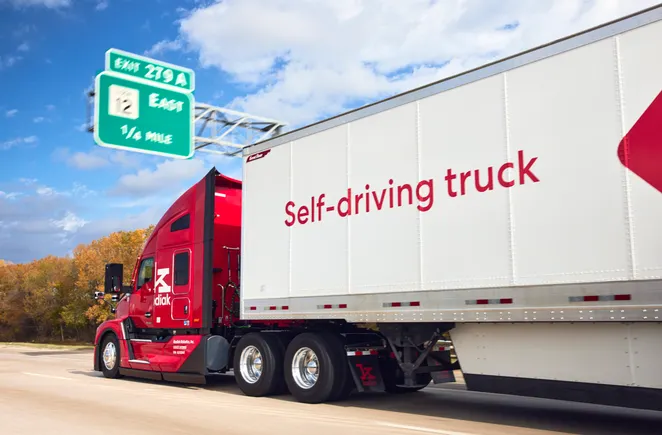
AUTONOMY / LOGISTICS
Autonomous freight is moving from edge lanes to core corridors
Kodiak is expanding its autonomous trucking program to the Midwest, running driverless operations on the I‑70 corridor between Ohio and Indiana, per Trucking Dive.
This moves AV freight from Sun Belt pilots into a core national freight artery, bringing major shippers and carriers into direct contact with blended human/AV networks.
The Bet: Autonomy can operate reliably enough on key interstate corridors that shippers will accept new SLAs, pricing models, and yard operations to capture cost and uptime advantages.
So What? This is the beginning of a structural rewrite of linehaul economics. Once AV trucks are running reliably on I‑70, the expectation will spread: 24/7 operations, different maintenance patterns, new bottlenecks at yards and transfer hubs. If you’re a shipper or carrier on these routes, your competitive position will increasingly depend on how quickly you can integrate AV capacity, not whether you “believe” in autonomy.
The Risk: Regulatory incidents, high-profile accidents, or labor pushback can slow or fragment deployment by state and corridor. If you overbuild processes around a single AV partner or lane, you’re exposed to policy and PR shocks.
Action: • If you move freight on I‑70 or adjacent corridors, initiate conversations with AV providers now, even just for shadow runs or pilot volumes. • Have your ops team model a blended network: what happens to cost, transit time, and yard utilization if 10–20% of your linehaul goes AV in the next 24 months. • Start updating contracts and SLAs to account for AV-specific terms, liability, handoff points, and service windows that assume 24/7 rolling capacity.
IN PRACTICE
The throughline across these rails is control: over compute, over model behavior, over identity, over data, over logistics.
When we work with operators on AI roadmaps, we start with a simple inversion: assume every external dependency you have, model, chip, identity provider, data source, will change materially within 18 months.
Then design for graceful failure.
That means: abstraction layers in your architecture, contractual hooks for change, and operational drills for “what if this vendor or model disappeared next quarter?” It’s not paranoia, it’s acknowledging that the stack is still in flux and building an organization that can absorb shocks without pausing execution.
For the full breakdown, reach out for a Field Report.
CONTRARIAN SIGNAL
Model quality isn’t the moat, stability is
The loudest story yesterday was “Claude got worse and more expensive.” The instinctive reaction is to treat this as a model-quality problem, one lab’s tuning misstep.
That’s the wrong frame.
The real story is that everyone has been treating frontier models like static infrastructure, “call gpt‑X, call Claude‑Y”, when they behave more like living services that change weekly. In that world, the moat isn’t having the “best” model on any given day. It’s having the most predictable, observable, and controllable behavior over time.
If you’re an operator, your competitive edge won’t come from picking the right model vendor in 2026.
It will come from building the discipline and tooling to ride model volatility without your product or margins blowing up every time an upstream lab ships a new checkpoint.
The Takeaway: Stop optimizing for peak benchmark scores and start optimizing for behavioral stability under change. The winners will be those who treat models as volatile commodities behind a resilient control plane, not as sacred infrastructure.
THE QUESTION FOR TODAY
Your chips are about to have a public-market alternative. Your primary model vendors are re-optimizing around enterprise distribution. Your users are learning that “the same” model can change behavior and cost overnight. Your identity and data surfaces are being financialized by third parties you don’t control.
Are you architecting your organization for a world where every external dependency is unstable, or are you still planning as if the stack will sit still for the next three years?
⸻
See exactly how this impacts your specific industry and function. Upgrade to PRO to get bespoke tactical breakdowns generated instantly for your operating model.
Go deeper with the Weekly Signal
This is the daily take. The Weekly goes further — full strategic analysis across 8–10 sections, each with a signal read and operator action items. Source panel included.
Sign up free → then upgrade