

AI labs buying dead startups’ Slack archives. The White House warming to Anthropic’s “spooky” model. Chrome turning AI Mode into a first-class surface. A seven‑month‑old infra startup racing to a $2B valuation while investors publish charts showing capital concentration at the top.
On the surface, it’s a random grab bag: policy, infra, browsers, venture.
Underneath, it’s one story: control over where AI learns, who it serves, and what stack gets standardized.
Compute is scarce, but data is becoming proprietary fuel. Governments are about to anoint reference models. Browsers are quietly becoming the default agent runtime. And capital is concentrating into a handful of infra and agent-native players who can afford to buy both compute and exhaust.
If your plan assumes “we’ll just plug into the best model and ride the wave,” you’re late. The game is shifting from “which model” to “whose data, whose surface, whose standard.”
BLUF
At Neue Alchemy, we support leaders navigating inflection points, when tech, capital, and policy converge. If your roadmap is already in motion and you're pressure-testing execution, we're open to conversations.
We also reserve capacity for education, SMBs, and mid-market leaders, those starting, mid-flight, or seeking outside perspective before systems harden.

POLICY / REFERENCE MODELS
The US is about to pick a de facto high‑stakes model
White House, The administration is reportedly ready to drop its prior friction with Anthropic and embrace its new Mythos model across federal agencies, per Gizmodo.
This would make Mythos a reference point for “spooky” capabilities, high‑stakes reasoning, security posture, and alignment, in sensitive government workflows.
The Bet: The US government is assuming that standardizing on a single frontier‑grade model for critical workflows is safer and more governable than a fragmented, multi‑model landscape.
So What? If Mythos becomes the default across agencies, the US effectively blesses a specific interface, safety profile, and capability envelope as “acceptable” for regulated work. That cascades into procurement templates, compliance checklists, and integration patterns that vendors will have to match. It also shifts the Overton window on what’s considered deployable in public sector, once one high‑capability model is in, arguing that others are “too risky” gets harder.
The Risk: A single reference model creates concentration risk, operational, security, and political. It also risks freezing innovation in public workflows around one vendor’s roadmap and safety philosophy, even as other models surpass it on specific tasks or modalities.
Action: • If you sell into government, map your stack against Mythos’ expected API, safety controls, and audit features, and start aligning your compliance story to that reference. • If you’re an enterprise in regulated sectors, assume your regulators will quietly mirror federal choices, start scenario‑planning for “Mythos‑like” requirements in your own vendor assessments. • If you run your own models, prepare a comparative brief this week: where your internal stack is stronger/weaker than Mythos for your use cases, this becomes your narrative when boards and regulators ask “why not just use the government model.”

DATA / AGENT TRAINING GROUNDS
Your collaboration exhaust is now training capital
AI labs, Labs are buying Slack, Jira, and email archives from defunct startups to build “reinforcement learning gyms” and train AI agents in simulated workplaces, per Forbes.
These datasets provide end‑to‑end traces of real teams making decisions, escalating issues, and closing loops, exactly the substrate agentic systems need to learn organizational behavior.
The Bet: Labs are assuming that whoever controls the richest, most realistic “office exhaust” will own the most capable enterprise agents, and that buying it from liquidators is faster than waiting for synthetic data or opt‑in partnerships.
So What? Collaboration data, Slack threads, ticket histories, email chains, just became a strategic asset class, not operational exhaust. That changes the liquidation math: your data room is no longer just IP and customer lists, it’s behavioral training fuel. For operators, it means your internal communications are on a path to becoming someone else’s agent’s muscle memory unless you explicitly control retention and sale rights.
The Risk: If you don’t lock this down, your proprietary workflows, escalation patterns, and even failure modes can be learned, and generalized, by models that later power competitors or adversaries. On the lab side, training on acquired archives without clear consent chains invites regulatory and reputational blowback once these practices surface in more detail.
Action: • This week, review your collaboration tools’ terms and your own employment/contractor agreements, explicitly classify Slack/Jira/email content as IP with restrictions on transfer and resale. • Add “data disposition on insolvency/acquisition” to your board‑level risk register, work with counsel to define what can and cannot be sold if things go sideways. • If you’re building agents, stop assuming “public internet + docs” is enough, start designing for proprietary, longitudinal workflow data collection with explicit user and customer consent.

BROWSER / INTERFACE POWER
Chrome is turning into the default agent runtime
Google, Chrome’s AI Mode now lets users open links side by side with the AI panel on desktop and search across multiple tabs on desktop and mobile, per TechCrunch.
AI Mode is no longer a modal helper, it’s a persistent, context‑aware surface that sits next to whatever the user is doing in the browser.
The Bet: The browser, not the OS, not standalone apps, will be the primary orchestration layer for knowledge work agents, and Google intends Chrome to be that layer.
So What? If AI Mode becomes a habit, Chrome owns the “what should I do next?” moment across SaaS, docs, and the open web. That compresses the value of in‑app copilots that rely on users context‑switching into their UI for search, summarization, or navigation. It also gives Google a privileged view of cross‑app workflows, the exact data needed to train meta‑agents that can operate any web app on the user’s behalf.
The Risk: If you’re a SaaS vendor, your UX and differentiation risk being abstracted behind a generic browser‑level agent that handles 80% of user intent. For enterprises, routing sensitive workflows through a consumer browser’s AI layer raises governance and data residency questions that most IT policies are not yet written to handle.
Action: • Instrument where your users currently leave your app to “go search” or “go summarize”, assume those hops will be intercepted by Chrome AI Mode and design in‑app flows that are faster or more trusted than the browser overlay. • If you’re IT or security, update your browser standards this week, decide whether AI Mode is allowed, restricted, or disabled for specific roles and data types, and communicate that clearly. • If you’re building agents, treat the browser as a primary deployment target, design for side‑by‑side, context‑aware experiences rather than yet another standalone chat window.

CAPITAL FLOWS / INFRA STRUCTURE
Infra is frothy, but concentrated, and networking is the new choke point
Upscale AI, The AI networking infrastructure startup is reportedly in talks to raise $180M–$200M at a $2B valuation, its third funding round in seven months, to build systems that move data efficiently between GPUs, per Bloomberg and TechCrunch.
The company is betting that the real constraint in large clusters is interconnect performance and software‑defined networking, not just raw GPU count.
The Bet: Investors are assuming that whoever solves AI networking at scale captures outsized economics, and that speed to land and expand with hyperscalers matters more than near‑term profitability.
So What? Three rounds in seven months at a $2B mark tells you two things: capital is still willing to overpay for perceived leverage in the infra stack, and the bottleneck has moved from “get GPUs” to “keep them fed efficiently.” For infra buyers, that’s leverage, vendors need volume and logos to justify these valuations. For everyone else, it’s a reminder that the stack is re‑pricing around throughput, not just FLOPs.
The Risk: Locking into a young networking vendor at scale introduces platform risk, if the company’s roadmap or economics wobble, your cluster efficiency and uptime go with it. On the investor side, over‑concentration in a few infra bets can backfire if hyperscalers decide to build in‑house or standardize on open alternatives.
Action: • If you’re negotiating with infra vendors, networking, orchestration, or GPU clouds, use this funding froth to push for long‑term pricing, credits, and roadmap commitments this quarter. They need committed workloads more than you need their logo. • Ask your infra team this week: “Where is our actual bottleneck, GPUs, interconnect, storage, or power?” Reallocate optimization effort and budget to the slowest link, not the noisiest vendor. • If you’re an infra startup not in the anointed tier, stop chasing mega‑rounds, design for profitability on smaller, stickier segments and for being a strategic acquisition, not a standalone unicorn.
Venture market, Q1 data shows a handful of large U.S. AI companies capturing the bulk of global venture dollars, leaving the rest of the market in a functional funding drought, per Crunchbase News.
The Bet: LPs and GPs are assuming that AI returns will follow a power law even more extreme than SaaS, better to double down on a few perceived winners than spread bets across the long tail.
So What? If you’re not already on the short list of “AI darlings,” equity is now both scarce and expensive. That shifts the startup playbook from “raise to find product‑market fit” to “earn your way there with revenue, strategic capital, or ecosystem piggybacking.” For operators at incumbents, it means fewer well‑funded challengers, but the ones that do emerge will be heavily capitalized and deeply integrated into hyperscaler or model‑lab ecosystems.
The Risk: Over‑concentration raises systemic risk, if one or two of the anointed players stumble, a lot of capital and ecosystem bets go with them. It also risks starving genuinely differentiated but unbranded innovation that doesn’t fit the current narrative.
Action: • If you’re a founder outside the top tier, stop optimizing for vanity valuation, optimize for runway and strategic distribution. This week, identify 2–3 potential ecosystem partners whose platforms you can ride instead of trying to out‑raise them. • If you’re a corporate, assume your best innovation pipeline is now partnerships and acqui‑hires, not waiting for a broad startup field to mature, start mapping who in your domain is under‑funded but technically strong. • If you control a budget, treat equity in your own company as more expensive than vendor lock‑in, in some cases, pre‑paying for infra or embedding with a hyperscaler is cheaper than raising another dilutive round.
COMPUTE / MACRO CONSTRAINTS
The AI constraint is shifting from ideas to power and politics
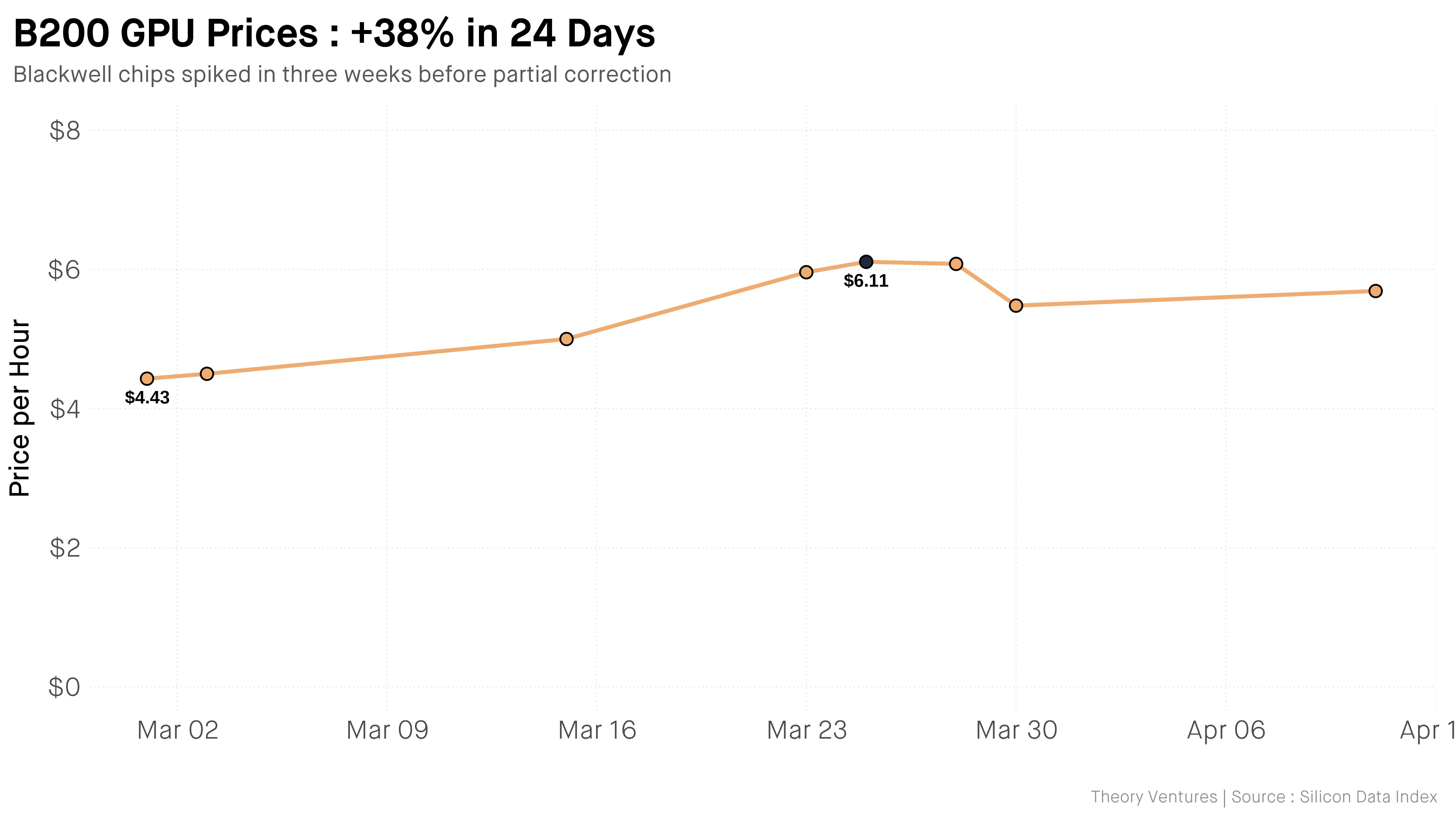
AI compute, Analysis circulating on Hacker News argues we’re entering an AI compute crisis, where the limiting factor on AI progress is no longer model ideas but access to power, chips, and priority on shared clusters, per Tom Tunguz.
The piece highlights rising GPU prices, long queue times, and power constraints as structural, not temporary, issues.
The Bet: The ecosystem is assuming that demand for frontier‑grade compute will outstrip supply for years, and that whoever secures long‑term access to power and chips will control the pace of innovation.
So What? Compute is becoming prime real estate: reserved early, priced dynamically, and increasingly bundled with capital. That changes your roadmap math, the question is no longer “what can we build?” but “what can we afford to run, and when?” It also means that non‑frontier workloads, fine‑tuning, inference for line‑of‑business apps, will be squeezed when demand spikes from labs and hyperscalers.
The Risk: If you assume today’s spot prices and availability will hold, you’ll under‑budget and over‑promise. On the flip side, over‑rotating to “compute scarcity” can paralyze teams that actually need modest, predictable capacity and can run on older hardware.
Action: • Build a compute risk register this week: list your top 5 AI workloads, their hardware requirements, and what happens if capacity is delayed 3–6 months. • Where possible, design for hardware flexibility, ensure your models and pipelines can run acceptably on last‑gen GPUs or mixed clouds, not just the latest H‑class. • If AI is core to your product, treat compute commitments like office leases, negotiate multi‑year reservations with clear SLAs rather than living on spot markets.
Data centers, Executives are increasingly worried about the industry’s toxic public image and growing local pushback, from zoning fights to moratoria, as they try to deploy trillions in capex, per Business Insider.
Communities are pushing back on water use, power draw, and land impact, turning “social license to build” into a gating factor alongside power and permitting.
The Bet: Operators are assuming they can manage community and regulatory risk with PR, incremental efficiency gains, and selective concessions, without fundamentally changing siting or engagement models.
So What? The constraint on your AI roadmap is no longer just chips, it’s whether the data centers you depend on actually get built where and when planned. Local politics is now part of your infra risk surface. For enterprises, that means your “cloud” is not abstract, it’s a set of physical sites that can be delayed, downsized, or canceled based on community sentiment.
The Risk: If you ignore this, you can wake up to capacity shortfalls or latency surprises because a planned region didn’t come online. For data center operators, underestimating reputational drag risks heavier‑handed regulation that’s harder to negotiate around later.
Action: • Ask your cloud reps this week which regions you’re most dependent on, and what local permitting or community risks exist there. Don’t accept “we’re on track” without specifics. • If you’re siting your own facilities, treat community engagement as a first‑order design constraint, not an afterthought, budget time and money for it like you would for transformers and cooling. • For AI‑heavy products, design for regional failover, assume one or more preferred regions become constrained or politically sensitive and plan routing accordingly.
IN PRACTICE
Treat data, compute, and surfaces as a single system
Most teams still plan these three independently:
Data strategy lives with product and legal. Compute planning lives with infra and finance. Interface strategy lives with product and design.
Yesterday’s moves show they’re now tightly coupled.
If your collaboration exhaust can be sold as training fuel, your data retention policy is a competitive weapon, or a liability. If Chrome is about to front‑run your in‑app copilot, your interface strategy has to assume a hostile but powerful intermediary. If compute is scarce and politically constrained, your model choices and product promises have to reflect that scarcity.
The operators who win this cycle will treat “what we collect,” “where it runs,” and “where it shows up” as one design problem, not three committees.
For the full breakdown, reach out for a Field Report.
CONTRARIAN SIGNAL
The real AI moat isn’t your model, it’s your liquidation terms
The loud narrative: “Data is the new oil, models are the refineries, compute is the pipeline.”
The quiet reality: your Slack archives are being auctioned off as training gyms, your browser is becoming the default agent shell, and your cloud capacity depends on a town council’s vote.
Everyone is obsessing over which frontier model to standardize on. The structural leverage is upstream and downstream, in who owns the behavioral exhaust that trains agents, and who controls the surfaces and power where those agents run.
If your contracts, retention policies, and interface bets don’t reflect that, your “AI strategy” is just a procurement plan.
The Takeaway: Treat liquidation rights, browser surfaces, and regional compute as core parts of your moat design, not legal boilerplate or UX details.
THE QUESTION FOR TODAY
Your browser is turning into an agent console. Your collaboration exhaust is being reclassified as training fuel. Your compute depends on politics as much as on chips. Your investors are concentrating their bets elsewhere.
Are you still planning around “which model to use”, or around the parts of the stack you can actually control?
See exactly how this impacts your specific industry and function. Upgrade to PRO to get bespoke tactical breakdowns generated instantly for your operating model.
Go deeper with the Weekly Signal
This is the daily take. The Weekly goes further — full strategic analysis across 8–10 sections, each with a signal read and operator action items. Source panel included.
Sign up free → then upgrade