


Robotaxis in San Francisco. Zero‑code agents for warehouse robots. A leaked memo about “attacking” a rival AI lab. A bank CEO talking publicly about AI cyber risk. A $500 jump on mainstream AI laptops.
The throughline isn’t “AI progress.” It’s that the stack is hardening into three fronts: embodied automation, model power as both asset and liability, and the cost of being “AI‑ready” in hardware and policy.
On the ground, robots are leaving the lab and entering premium services and brownfield warehouses, and the bottleneck is shifting from motion planning to orchestration and uptime. In the cloud, advanced models are now treated as both strategic differentiators and national‑security‑grade risk. At the edge, endpoint hardware and political capital are repricing around AI as a first‑class requirement.
If your current plan assumes you can “wait for the dust to settle” before committing to robotics, model vendors, or hardware refresh, you’re misreading the moment. The dust is the operating environment now.
BLUF
At Neue Alchemy, we support leaders navigating inflection points, when tech, capital, and policy converge. If your roadmap is already in motion and you're pressure-testing execution, we're open to conversations.
We also reserve capacity for education, SMBs, and mid-market leaders, those starting, mid-flight, or seeking outside perspective before systems harden.
ROBOTICS / EMBODIED AI
Robots are now a software and business‑model problem, not a science project
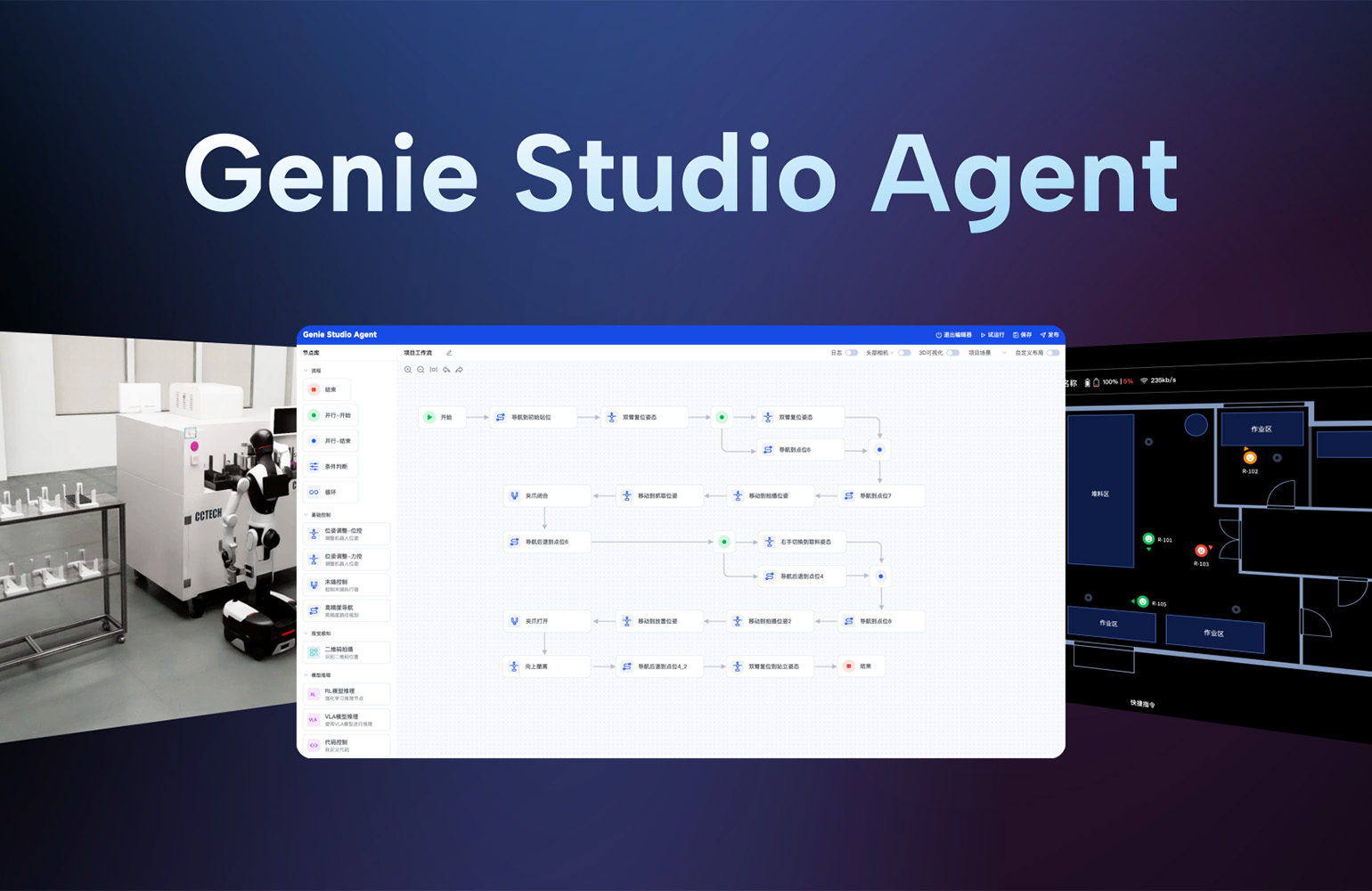
AGIBOT launched Genie Studio, a zero‑code “agent” application platform for robots, aimed at letting non‑programmers compose and deploy robot workflows across hardware, per The Robot Report.
The platform abstracts robot control into higher‑level tasks and agents, the promise is compressing time from hardware purchase to production deployment by shifting integration into a visual, ops‑friendly layer.
The Bet: Robot vendors are assuming that the limiting factor for adoption is not capability, but the scarcity of specialized integrators and controls engineers.
So What? The constraint on warehouse and light‑manufacturing automation is moving from “can the robot do it” to “who wires it into our workflows.” Zero‑code orchestration means your operations team becomes the primary integrator, not your SI. That changes who you hire, who owns the P&L, and how fast you can iterate on physical workflows.
If this class of tool works, the advantage shifts to organizations with clean process maps and disciplined change management, not just those with capital to buy hardware. The winners will be the teams that treat robots like software releases, with versioning, rollback, and A/B testing on the floor.
The Risk: If you hand orchestration to non‑specialists without guardrails, you trade integrator bottlenecks for safety, reliability, and compliance risk. And if vendors fragment around proprietary “agent studios,” you’ll get locked into one ecosystem before standards emerge.
Action: • Inventory your top 5 repetitive physical workflows and document them as if they were software, triggers, states, exceptions. • Identify 1–2 operations leaders who can own “robot orchestration” as a product role, not a side task. • When talking to robot vendors this week, ask to see their deployment tooling and uptime data, not just their demo videos.
Uber and Nuro began testing a premium robotaxi service in San Francisco using Lucid electric vehicles for Uber employees, per TechCrunch.
The pilot focuses on higher‑end rides with a safety driver in the loop, framed as an internal testbed before broader rollout.
The Bet: Autonomy will be subsidized first by premium experiences, not mass‑market cost savings, with high‑margin riders funding the autonomy stack.
So What? Automation is coming for your highest‑value customer segments first, not your lowest. The assumption that “robots start with low‑end commoditized work” is breaking, in mobility, the early economics favor premium, predictable routes and customers who will pay for novelty and reliability.
If you run fleets, logistics, or mobility services, your most profitable lane is now the one most at risk of being automated and rebundled by platform partners. The strategic question is whether you become the autonomy customer, the autonomy partner, or the autonomy layer yourself.
The Risk: If regulators or local politics slow premium robotaxi approvals, you can end up over‑invested in autonomy partnerships that don’t scale beyond pilots. And if you hand the customer relationship to a platform during the “premium novelty” phase, getting it back later will be expensive.
Action: • Map your top 10 revenue‑dense routes or customer segments and score them for autonomy suitability, distance, predictability, regulatory complexity. • Start a structured conversation with at least one autonomy vendor about co‑branded or white‑label offerings, not just “we’ll list on your marketplace.” • Update your 3‑year fleet capex plan to include a scenario where 10–20% of premium volume is handled by autonomous units, whether owned or partnered.
Pickle Robot is publicly sharing lessons from deploying its unloading robots from lab to field, emphasizing “commercially viable” deployments and real‑world integration challenges, per Robotics Business Review.
The focus is on uptime, integration with existing warehouse systems, and the messy realities of operating in non‑controlled environments.
The Bet: The next wave of robotics differentiation is deployment playbooks and MTBF, not just cycle‑time benchmarks.
So What? Warehouse robotics is standardizing around “who can keep robots running in ugly, variable conditions” rather than “who has the slickest demo.” That means your due diligence needs to look like industrial equipment procurement, field data, service SLAs, integration history, not like a SaaS RFP.
Vendors that publish their scars are signaling maturity. If you’re still judging robots on conference‑floor demos, you’re behind the buyers who are benchmarking on uptime and integration cost per dock door.
The Risk: If you over‑index on a single vendor’s playbook, you risk designing your operations around their constraints, and paying switching costs later when multi‑vendor or new modalities become necessary.
Action: • Ask current or prospective robotics vendors for anonymized uptime and MTBF data from at least 3 live customer sites. No data, no deal. • Send an ops lead, not just IT, to vendor reference calls focused solely on integration pain and support responsiveness. • Build a small “robotics sandbox” zone in one facility where you can trial multiple vendors under your real conditions before committing.
MODELS, RISK, AND POLICY
Frontier AI is now a board‑level risk and a political actor
Goldman Sachs CEO David Solomon said the bank is working with Anthropic on AI cyber risks after concerns around Anthropic’s new Mythos model, explicitly flagging AI as both a tool and a threat vector, per Business Insider.
The collaboration focuses on understanding how advanced models change the cyber risk landscape for a global financial institution.
The Bet: Large enterprises are assuming that model vendors must be partners in threat modeling, not just API providers.
So What? AI model risk has graduated from “interesting CISO topic” to “CEO‑level talking point.” When a Tier‑1 bank CEO is naming a specific model in the context of cyber risk, every board in regulated industries just got a new agenda item: how do we treat models as both infrastructure and potential adversary capability.
This collapses the separation between AI, security, and compliance. Your AI vendor choice is now a security architecture decision and a regulatory posture decision, not just a feature comparison.
The Risk: If you outsource too much of your threat model to your model vendor, you risk inheriting their blind spots and incentives. And if regulators move faster than your internal governance, you’ll be reacting to compliance mandates instead of shaping them.
Action: • Convene a joint session this week between your CISO, head of AI/ML, and legal to draft a single threat model that includes model misuse, prompt‑based exfiltration, and supply‑chain risk. • Ask your primary model vendors for their red‑teaming reports and incident response processes, and how they’ll notify you of model‑level vulnerabilities. • Update your vendor risk questionnaire to treat model providers like critical infrastructure, not generic SaaS.
A leaked internal memo from an OpenAI executive described a new strategy to “attack” Anthropic, signaling a more aggressive posture toward a rival lab, per Gizmodo.
The language surfaced in the context of competitive positioning and market share, not research collaboration.
The Bet: Frontier labs are operating on the assumption that this is now a zero‑sum commercial market where narrative, distribution, and policy influence are as important as raw capability.
So What? The era of “we’re all in this together” among labs is over. For enterprises, that means your AI stack is now entangled with vendor go‑to‑market aggression, lobbying, and PR campaigns. Expect more aggressive discounting, bundling, and exclusivity pushes, and more pressure to “pick a side” in ecosystems.
Vendor risk is no longer just “will the API be up”, it’s “how does this vendor’s competitive behavior intersect with our brand, our regulators, and our long‑term leverage.” Your AI strategy is now a geopolitical and ecosystem alignment choice.
The Risk: If you over‑commit to a single lab’s stack, especially under heavy discounting, you risk being collateral in future policy fights, export controls, or public controversies. And if you ignore the politics, your comms and policy teams will be cleaning up after your procurement decisions.
Action: • Build a dual‑vendor or multi‑vendor model strategy on paper, even if you only implement one this quarter, know your exit ramps. • In your next AI vendor negotiation, explicitly ask about data portability, model‑agnostic orchestration, and termination clauses. • Brief your comms and policy teams on your AI vendor choices and the labs’ public positioning so they’re not surprised when those names show up in headlines.
Anthropic hired Ballard Partners, a lobbying firm with strong ties to the Trump administration, days after the U.S. Department of Defense labeled the company a supply chain risk, per Techmeme/Bloomberg.
The move underscores a rapid escalation in direct political engagement following a federal risk designation.
The Bet: AI labs are treating Washington as a primary market and risk surface, not a compliance afterthought, and are investing accordingly.
So What? Policy is now existential for AI infrastructure providers. When a lab responds to a DOD supply chain risk label by immediately deepening its lobbying bench, it’s a clear signal: export controls, procurement rules, and security designations can reshape their addressable market overnight.
If your product depends on frontier models, chips, or cloud regions, you’re downstream of this. Your own policy posture, or lack of one, is now part of your operational risk. “We’ll just follow the rules when they’re written” is not a strategy.
The Risk: If you ignore the policy layer, you can wake up to a world where your primary vendor is constrained in your region or sector. Conversely, over‑rotating into one political camp can backfire across election cycles.
Action: • Map your critical AI dependencies, models, chips, cloud regions, and flag which are exposed to U.S. federal designations or export regimes. • Engage your government affairs or external counsel to understand how current and proposed rules touch your AI stack, not just your core business. • If federal contracts or regulated sectors are on your roadmap, start building relationships with neutral policy advisors now, before you need them.
Mark Zuckerberg was turned into an internal AI bot for Meta employees, a “Zuck bot” that answers questions in his voice and style, trained on his past communications and decisions, per Gizmodo.
The bot is positioned as an internal comms and culture tool, giving employees a persistent, AI‑mediated interface to leadership.
The Bet: Leadership presence and institutional memory can be productized as an internal AI surface, and that this will shape culture and decision‑making at scale.
So What? When the CEO becomes a bot, the org is admitting that internal communication, policy lookup, and “what would leadership say” are now AI‑native workflows. This is a structural shift: employees will increasingly ask the bot, not their manager, for guidance, context, and interpretation.
If you don’t build your own “founder/leadership bot,” your people will default to consumer assistants trained on the open web. That’s a governance problem and a culture problem. The question is whether your institutional knowledge lives in your systems or in someone else’s model.
The Risk: If the bot’s training data is stale, biased, or misaligned with current strategy, you’ll hard‑code outdated decisions into daily workflows. And if you roll this out without clear boundaries, employees may treat bot answers as policy, creating legal and HR exposure.
Action: • Audit your leadership communications, town halls, strategy docs, policy memos, and assess whether you have the corpus to train an internal leadership bot. • Define strict scopes for any internal persona bots: what they can answer, what they must defer, and how they log interactions for oversight. • Start with a narrow “policy and history” bot for internal use, then expand, don’t jump straight to a fully anthropomorphized CEO clone.

INFRASTRUCTURE / HARDWARE
The AI hardware tax is now explicit, and endpoint strategy is a budget decision
Microsoft raised prices for its Surface Laptop 7 and Pro 11 by $500 compared to their 2024 launch pricing, citing higher memory and component costs tied to AI‑capable hardware, per Windows Central.
The increase hits mainstream configurations, not just top‑end SKUs, and is framed as a response to component and AI feature costs.
The Bet: OEMs are assuming enterprises will absorb a higher per‑device cost in exchange for on‑device AI capabilities and modern specs.
So What? The AI hardware tax has arrived in your endpoint budget. A $500 jump on midrange devices, multiplied across a fleet, is a material capex hit, and it’s being justified by AI features most orgs haven’t fully operationalized yet.
This forces a strategic choice: do you pay for AI‑capable endpoints everywhere, or do you centralize intelligence in the cloud and keep clients thin? The wrong answer is “we’ll just refresh like we always have”, that’s how you end up with a bloated, underutilized hardware estate.
The Risk: If you over‑invest in AI‑heavy endpoints without a clear plan for on‑device workloads, you lock in higher depreciation with little productivity gain. If you under‑invest, you may find key workflows constrained by older hardware and OS support windows.
Action: • Segment your workforce into AI‑heavy, AI‑moderate, and AI‑light roles and map device specs to actual workload needs, not vendor marketing. • For AI‑light roles, model a thin‑client plus cloud approach and compare TCO against full AI laptops over a 3–5 year horizon. • Lock in pricing with your OEMs or resellers for the next 6–12 months where possible, and negotiate based on volume and role segmentation, not uniform SKUs.

CAPITAL / TALENT / ADOPTION
Capital is rotating back into deep tech, but adoption is on industrial timelines
Asia’s startup funding hit $27.4B in Q1 2026, up roughly 20% quarter‑over‑quarter and nearly 2x year‑over‑year, with China leading and AI plus deep tech as key drivers, per Crunchbase News.
The rebound marks the highest level in more than three years, with a notable tilt toward seed and growth rounds in AI, semiconductors, and advanced manufacturing.
The Bet: Capital is assuming that the next wave of value in Asia will come from infrastructure and deep tech, not just consumer apps.
So What? If you’re a Western founder assuming Asian capital is sidelined, that assumption is now wrong. Asian investors are back in size and are comfortable underwriting AI, chips, and industrial tech, the same spaces Western capital is chasing. That means more competition for talent, IP, and market share, and more cross‑border dealmaking.
It also means your competitive set is not just Silicon Valley and Europe. A Chinese or broader Asian startup with deep local capital and government alignment can move faster on hardware, manufacturing, and regional deployment than a Western peer.
The Risk: If you ignore this capital rotation, you risk being surprised by well‑funded Asian competitors entering your markets or undercutting you on cost and speed. Conversely, chasing Asian capital without understanding local regulatory and political dynamics can create entanglements you’re not ready for.
Action: • Update your competitive landscape to include Asia‑based players in your category, especially in AI infra, robotics, and chips. • If you’re fundraising, map which Asian funds are active in your stage and sector and decide deliberately whether they belong on your cap table. • For hardware or manufacturing‑heavy businesses, explore Asian partnerships now, before supply chains and standards harden around other players.
An AWS VP said the future will be “frustrating” for engineers seeking a “pure software development career,” emphasizing the need for customer skills and system‑level thinking, per Business Insider.
The message is that engineers who understand customer context and outcomes, not just code, will have the most leverage.
The Bet: Cloud providers are assuming that the highest‑value engineers will be those who can bridge technical depth with product and stakeholder fluency.
So What? The “just write code” career path is being de‑emphasized at the infrastructure layer. As AI automates more of the boilerplate, the leverage shifts to engineers who can own problem definition, customer discovery, and system outcomes. That has direct implications for how you hire, promote, and retain technical talent.
If your org still rewards lines of code and ticket throughput over customer impact and cross‑functional leadership, your best engineers will leave for roles where they can own more of the stack, or where AI is a force multiplier, not a threat.
The Risk: If you over‑rotate into “everyone is a product engineer” without preserving deep technical tracks, you’ll burn out specialists and underinvest in core infrastructure. And if you ignore this shift, you’ll end up with a team great at implementation but weak at choosing the right problems.
Action: • Review your engineering career ladder this week and check whether customer impact and system ownership are explicitly rewarded at senior levels. • Identify 3–5 engineers with strong communication skills and give them structured exposure to customers or internal stakeholders. • Start tracking and celebrating stories where engineers changed the problem definition, not just shipped the requested feature.
A viral comparison framed Google’s AI adoption curve as similar to John Deere’s, slow, methodical, ROI‑gated integration of general‑purpose tech into core products, per Hacker News/Twitter.
The analogy highlights that incumbents often adopt foundational technologies on industrial, not startup, timelines.
The Bet: Large incumbents will integrate AI deeply, but over 5–10 years, not 12–18 months.
So What? If your startup thesis assumes “BigCo will be fully AI‑native in a year,” you’re miscalibrated. The John Deere analogy is a reminder: incumbents move on capex cycles, regulatory reviews, and organizational change curves. They will adopt AI, but in phases, with ROI gates and safety reviews.
For operators inside incumbents, this is permission to design realistic roadmaps instead of chasing hype. For startups, it’s a warning to price runway and sales cycles around multi‑year adoption, not quarterly flip‑overs.
The Risk: If you underestimate the speed of specific pockets, like a single BU with strong leadership, you can be blindsided by faster‑than‑expected competitive responses. If you overestimate, you’ll run out of cash waiting for “AI transformation” budgets that are still in committee.
Action: • For each enterprise customer or BU, map AI adoption on a 5‑year curve: pilots, first production, scaled rollout, and align your sales expectations accordingly. • Inside large orgs, pick 1–2 high‑leverage workflows to fully AI‑enable end‑to‑end, rather than sprinkling pilots everywhere. • Adjust your fundraising narrative to emphasize durability and integration support over “quick displacement” of incumbents.
IN PRACTICE
Most teams are still treating AI and robotics as “projects”, discrete initiatives with a start and end, instead of as surfaces that will pervade workflows, hardware, and policy.
The operators who are getting this right are doing three things consistently:
They’re building dual‑track roadmaps, one for embodied automation, one for cognitive automation, and forcing them to intersect at the process level. The question isn’t “where can we use robots” or “where can we use LLMs,” it’s “how does this specific workflow change when both are available.”
They’re treating vendor selection as ecosystem design. Model providers, robot platforms, and hardware OEMs are chosen not just on capability, but on how they interact with regulators, how portable their stacks are, and how they align with internal governance.
They’re upgrading roles, not just tools. “Robot orchestrator,” “AI product owner,” and “policy‑aware architect” are becoming real jobs, with P&L responsibility and authority to say no.
For the full breakdown, reach out for a Field Report.
CONTRARIAN SIGNAL
AI “limits” aren’t a constraint, they’re your new scheduling primitive
The dominant narrative is that AI usage caps and hardware costs are frustrating constraints, users hoarding Claude sessions, CFOs balking at $500 laptop hikes, teams annoyed by rate limits.
The structural angle: these limits are forcing organizations to treat AI like any other scarce resource, compute, bandwidth, human attention. That’s not a bug. It’s the moment AI stops being a toy and becomes an operational input you schedule, budget, and govern.
Session caps are already reshaping workdays, people batch deep work for weekends or off‑peak hours. Hardware costs are forcing segmentation of who actually needs on‑device AI. Model risk is pulling CISOs and boards into vendor selection. The constraint is what’s making the system legible.
The Takeaway: If you design your workflows, budgets, and roles around AI as a scheduled, scarce resource now, you’ll be ahead of the orgs still pretending it’s “just another SaaS tool” with infinite capacity.
THE QUESTION FOR TODAY
Robots are leaving the lab and entering your warehouses and streets. Model vendors are now political actors and security partners. Endpoint hardware is quietly adding a per‑seat AI tax. Capital is rotating back into deep tech on 5–10 year horizons. Incumbents are adopting AI on industrial timelines, not startup fantasies.
Does your current roadmap treat AI and robotics as opportunistic add‑ons, or as constrained, political, and capital‑intensive resources you need to actively design around?
⸻
See exactly how this impacts your specific industry and function. Upgrade to PRO to get bespoke tactical breakdowns generated instantly for your operating model.
Go deeper with the Weekly Signal
This is the daily take. The Weekly goes further — full strategic analysis across 8–10 sections, each with a signal read and operator action items. Source panel included.
Sign up free → then upgrade


